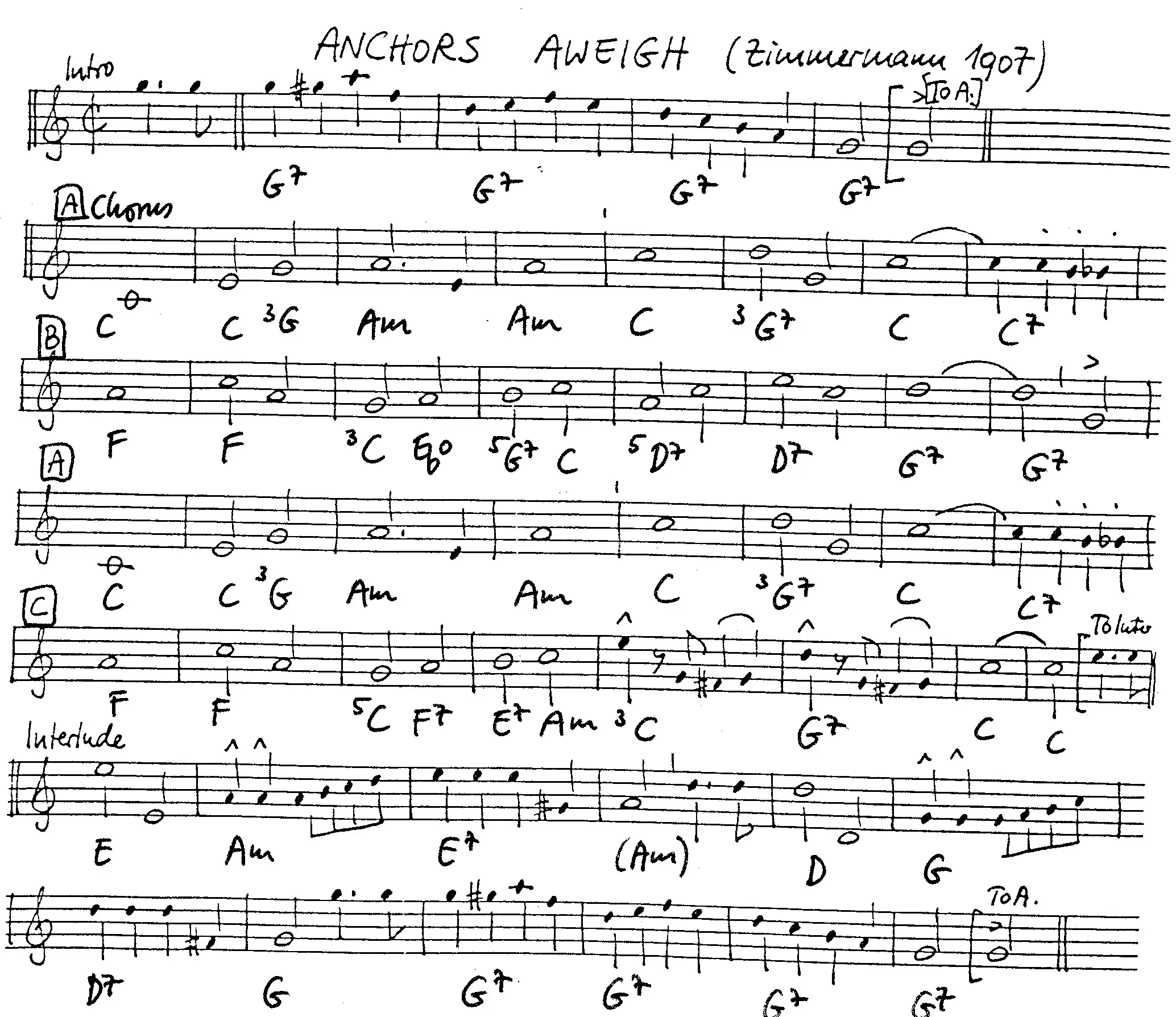
Anchors aweigh – Free Jazz Lead Sheet
C Major – Charles A. Zimmerman 1907
Anchors Aweigh was composed in 1907 by Charles A. Zimmerman, bandmaster of the United States Naval Academy. It became the official song of the U.S. Navy and is written in C major, making it suitable for jazz bands, brass ensembles, and ceremonial performances. A free online lead sheet is available for rehearsal, arrangement study, and adaptive performance.
Enjoyed this free leadsheet?
Support the projectAbout this song:
Anchors Aweigh was composed in 1907 by Charles A. Zimmerman, bandmaster of the United States Naval Academy. Written as a fight song for the Naval Academy class of 1907, it was later adopted as the official song of the U.S. Navy. Its strong melodic profile and driving march rhythm helped establish it as one of the most recognizable military songs in American history, frequently performed at ceremonies, sporting events, and patriotic occasions.
This free online lead sheet presents the complete melody and chord structure in C major, making it suitable for jazz bands, brass ensembles, school groups, and ceremonial performances. Musicians can use it for rehearsal, arrangement study, or adapting the tune to swing, big band, or contemporary instrumental settings.
About the composer: Charles A. Zimmerman
Charles A. Zimmermann (1861–1916) was an American composer and bandmaster known for his work in military and popular music. His most notable composition is "Anchors Aweigh," a 1906 march that became a staple in naval ceremonies. He also contributed to the 1902 play *The Wizard of Oz* and collaborated with other musicians, leaving a lasting impact on American musical culture.
Musical strucutre and form
Written in a traditional march form with repeated strain sections and commonly performed in C major, the piece features a strong duple-meter pulse, clear harmonic progressions, and bold melodic intervals. Its straightforward structure and functional harmony allow for effective adaptation to swing, big band, and jazz ensemble arrangements.